So I'm writing again. finally.
- Tammy Koehler Smith
- 3 days ago
- 7 min read
I stopped writing for a while. Years, actually, after my kids were born. They're in their late twenties now.
I won't get into the whole story of why, but at some point, I looked up and realized I had been "meaning to get back to it" for so long that getting back to it had started to feel like something other people did. Not me.
I've worked in digital marketing for the better part of twenty years, and I've written a lot of content during that time. But because none of it was truly from the heart, it always felt a little flat. By the last few years, I was convinced I simply didn't have what it takes to write creatively anymore.
Then inspiration hit.

D&D Was Your Inspiration To Write Again?
Short answer: Yep!
I have been doing D&D, thanks to my husband, since my firstborn was a couple of months old. He’d been playing since he was a teen, but he thought it would be a good outlet for us to see our friends while still staying at home to tend to the baby. Playing D&D led to DMing D&D and other RPGs, and creating those worlds is where I poured my creativity.
One of my favorite things to do, even now, is create RPG characters. I go all in and create elaborate backstories for each one. I have over 30 and am actively playing roughly two. I say “roughly” because I will dust one or two off to play at cons when I get the chance to play live in that arena. But my biggest inspiration happened recently when I created my bard, Xac.
I distinctly remember creating him; every piece just hit me. Not all at once, but in waves. I came up with the concept of a has-been once superstar. Then I realized he was in a famous band. Oh! No, make that a famous boy band. All five members' names came right to me, and I rattled off Gunther, Odo, and Becket. Brad came last. I knew it had to be so common and non-spectacular that it would be worth a laugh. I created him a couple of years ago to run through my husband’s Mad Mage campaign. But the backstory I created in my head lived large. I thought about it a lot. Then one day I said…
I’m Gonna Write a story about Xac’s Band
The book, The Mythic Sons, is set in a world called Vadura and centers on a fantasy boy band I accidentally created while building the backstory for a D&D character.
The band is ridiculous in the best possible way: a half-satyr frontman, a tiefling gitternist (guitarist, for modern audiences), a pixie Odosonic Vibrachime master (just you wait!), an orc vielliest (violin), and a minotaur percussionist. They travel a patchwork of kingdoms, making music, causing problems, and somehow remaining deeply fond of each other despite ample evidence that they probably shouldn't be.
That's most of the pitch.
What I didn't expect was how much time I'd spend figuring out what kind of fantasy I was writing. Because there are a lot of kinds now, and they're not all trying to do the same thing.

The Map of the Neighborhood
When I was reading fantasy as a kid, the genre mostly meant one thing: LoTR and other long books, well-written, beautiful, and probably a trilogy. There are elves, dwarves, maybe a dragon, and someone's probably going to die at the end. Epic fantasy. High fantasy. Big canvas, big stakes, the kind of thing where the map at the front is thirty percent of the reading experience.
That's not what I'm writing. Correction, not entirely what I'm writing. I've probably got elves, dwarves, and maybe a dragon, but still, we do not have epic battles; no one is slaying a dragon in my world. Not yet anyway. Why would they when they have each other to contend with? Real life. Real with air quotes because again, minotaur, satyr, pixie, orc, and tiefling. But back to the topic of fantasy...
Fantasy has sprawled considerably since I was young. There's grimdark, which takes the bleakness seriously and commits to it. There's romantasy, which is having a genuine cultural moment right now and is doing it on a grand scale with a lot of justified enthusiasm. There's portal fantasy, secondary world fantasy, fairy tale retellings, progression fantasy, LitRPG -- shout out to the DCC fans. I sure do love me some Princess Donut. There's a whole conversation happening right now about what fantasy is for and who it's for and what it gets to do.
The corner of it I keep coming back to is cozy fantasy.
What Cozy Fantasy Actually Is
When I was reading fantasy as a kid, the genre mostly meant one thing: long books, beautiful maps, and stories big enough to reshape the world. There were elves, dwarves, maybe a dragon, and somebody was probably going to save a kingdom—or die trying.
That's not entirely what I'm writing.
I've probably got elves, dwarves, and maybe a dragon, but there aren't any epic battles here. Nobody's slaying dragons. Not yet, anyway. My characters spend far more time navigating relationships, careers, old mistakes, and the complicated business of being people. Granted, they're people who happen to be satyrs, pixies, tieflings, orcs, and minotaurs, but still.
Fantasy has sprawled considerably since I was young. These days, there are countless subgenres, each emphasizing different parts of the experience. Grimdark leans into the harsh realities of its worlds. Romantasy is having a well-deserved cultural moment. Portal fantasy, progression fantasy, fairy-tale retellings, LitRPGs—there's an entire ecosystem of stories out there now. (A quick nod to the Dungeon Crawler Carl fans. Princess Donut remains an icon.)
The corner of fantasy I keep coming back to is cozy fantasy.
I've heard people describe cozy fantasy as "low stakes," which isn't quite right, or "nothing bad happens," which also misses the point. What makes cozy fantasy cozy isn't the absence of problems. It's that the emotional center of the story is belonging rather than survival.
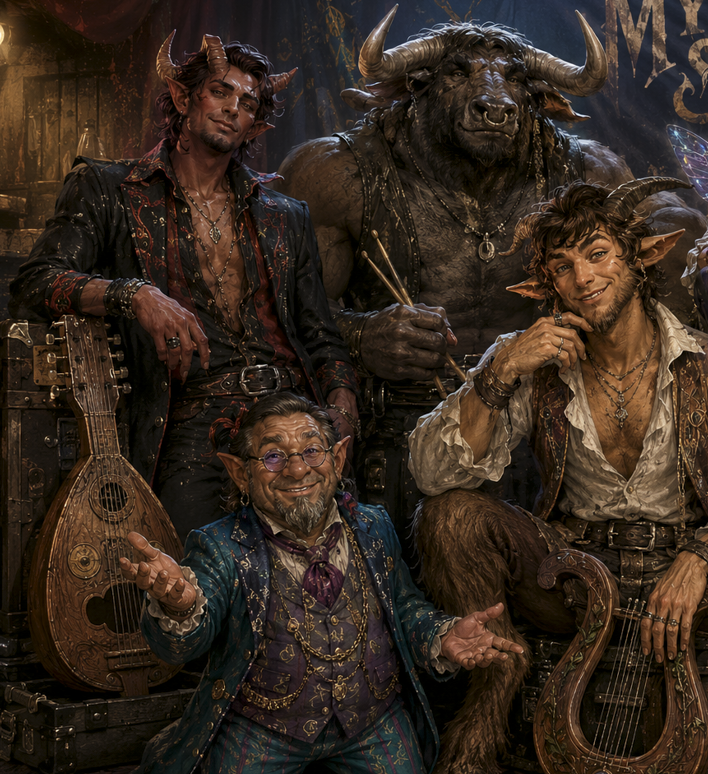
The characters have challenges. Sometimes serious ones. But the world isn't constantly trying to kill them, the people around them mostly mean well, and the story is more interested in connection than catastrophe. The journey matters. The world is somewhere you'd actually want to spend time.
That's where The Mythic Sons are.
Xac's life is messy. The band has problems. Relationships get complicated. Dreams don't always work out the way people hoped. The stakes are real—they're just human-sized.
That's exactly what The Mythic Sons is. Cozy.
Found Family as the Foundation
There's another label that fits The Mythic Sons, and it's one worth calling out on its own: found family.
The best found-family stories aren't really about people becoming friends. They're about people becoming necessary to one another. A collection of strangers who, through shared experiences, bad luck, stubborn loyalty, and more than a few questionable decisions, slowly become something that looks a lot like family.
That's what happens here.
The Mythic Sons didn't begin as a tight-knit group. They began as musicians thrown together by circumstance, ambition, and a manager who refused to take no for an answer. Friendship came later. So did trust. So did the realization that, somewhere along the way, they stopped being coworkers, bandmates, or traveling companions and became each other's people.
A large part of the story is about how those bonds form, how they're tested, and what it takes to keep them intact. If you're the kind of reader who enjoys watching a group of lovable disasters argue, annoy each other, make terrible choices, and then show up when it matters most, there's a good chance you'll feel right at home here.
The LGBTQIA+ and Inclusive Part
I've seen "inclusive fantasy" used as a marketing category, which is fine, but I want to be clear about what I mean when I use it: The Mythic Sons is a book where queer characters exist as naturally as anyone else. Their identities matter because they are part of who they are, but they aren't treated as problems that need solving.
That doesn't mean those identities never affect the story. They do. Relationships change. People grow into themselves. Secrets come out. But the conflicts in the book come from being people rather than from a world determined to punish them for existing.
Vadura doesn't share our particular history of who gets to belong, and that choice is deliberate. That doesn't mean everyone in Vadura is nice. They are not. You haven't met the Drahel yet (I'll leave that for my husband to introduce to you).
The same idea of belonging goes for the band's general composition as well. Xac is half-satyr. Brad has horns (possibly a tail—it's still early days). Gunther is roughly the size of a boat. Nobody treats these things as obstacles to overcome. The world is simply built that way.
Queer characters exist without apology in my book, and as far as I’m concerned, should exist equally in our world, too. I am trying to write the kind of world I'd like to spend a few hundred pages in. As the mother of two amazing children, one of whom just happens to be trans, the world isn’t always good enough for the amazing souls who live in it. Maybe fantasy can do a little better.

Where This All Leaves Me
Cozy fantasy. Found family. Queer characters who exist without apology. Inclusive by construction rather than by addition. A boy band with a sentient lyre.
That's the book. I don't know if it fits cleanly into any shelf at the bookstore — it probably goes in two or three places depending on who's shelving it — but I know what it's doing and why, which is more than I had when I first started writing it.
The getting-back-to-it is going okay. I'll keep you posted.
Happy Pride Month, everyone!